After more than twenty years working in Devon gardens, I’ve found that the most rewarding projects aren't just about how a border looks the afternoon you sweep down the path—they’re about how the person living there connects with the space afterwards.
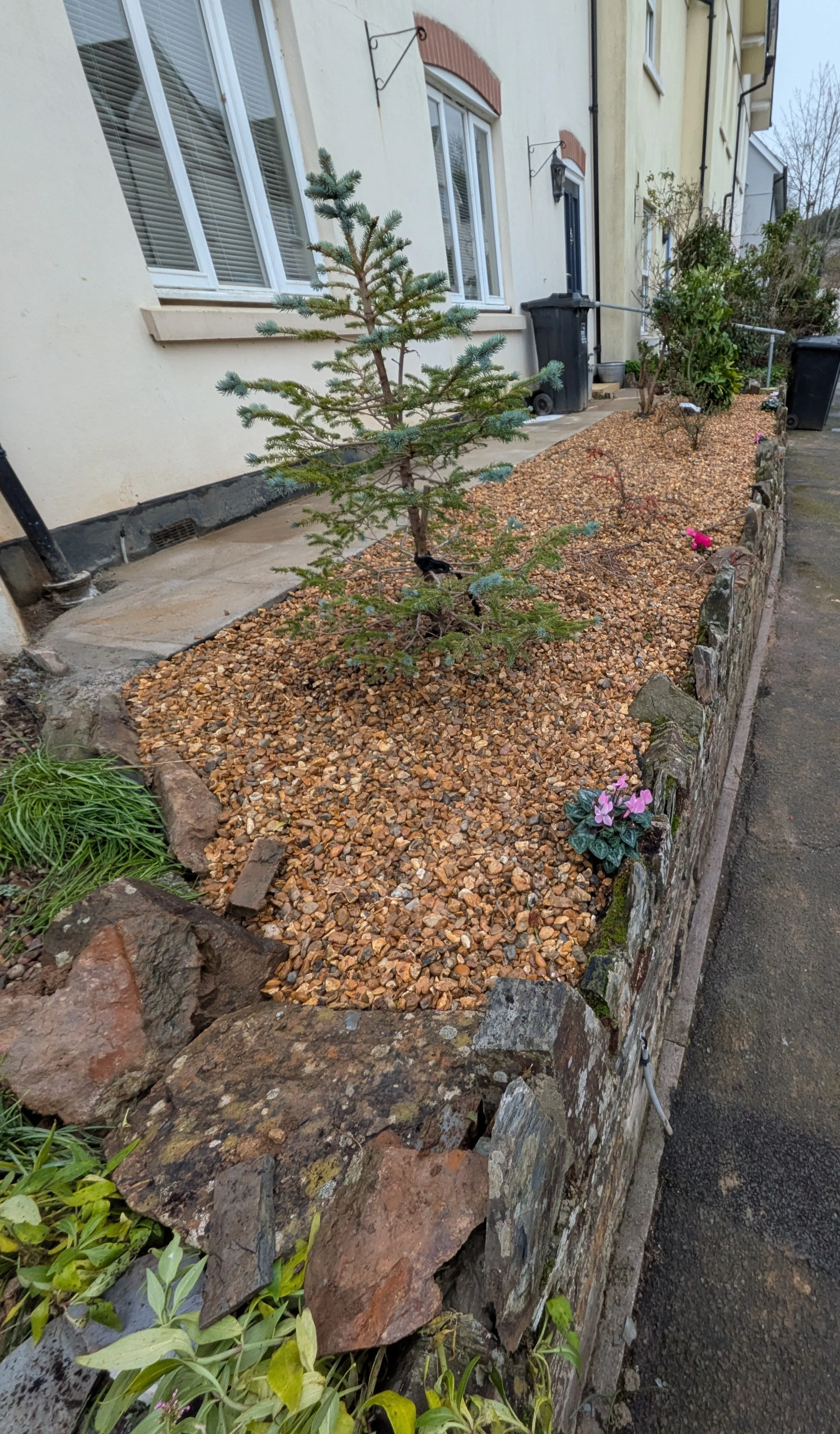
This week I finished a multi-stage front garden overhaul here in Totnes for a homeowner named Adam, organised with his sister Sarah. On the practical side, the brief solved two classic town-garden headaches: doubling an awkwardly narrow single-file concrete path with 14 non-slip flags so there’s safe winter footing past the wheelie bins, and replacing a weedy roadside bed with heavy-duty woven membrane and warm golden flint shingle.
Turning a Low-Maintenance Border Into a Living Wildlife Project
"Low maintenance" should never mean sterile. A local blackbird (Turdus merula) had already taken a liking to the frontage, so every plant running from the front steps down to the mossy rockery boundary was chosen to earn its keep without demanding heavy upkeep:
Layered Shelter and Lookouts: Pairing glossy Spotted Laurel (Aucuba japonica) and winter-budding Laurustinus (Viburnum tinus) near the steps with a young blue-green Spruce (Picea) at the far rockery end gives shy garden birds safe cover and perching posts at both ends of the border.
Staggered Winter Berries: Matching a new herringbone Cotoneaster horizontalis alongside the established one builds a generous mid-winter berry larder right outside the window, while a compact Japanese Skimmia (Skimmia japonica) holds its scarlet berries by the front door right into late winter, joined by four pockets of hardy pink and lilac Cyclamen tucked along the weathered slate coping wall.
Sharing Curiosity With a Custom Botanical Guide
Once the planting was finished, Sarah mentioned that Adam loves looking things up online and asked for a sequential guide to the plants from the steps to the boundary so he could research their backgrounds and follow them through the seasons.
Putting together an illustrated Front Garden Botanical & Blackbird Guide (PDF) for him was a great reminder of why good horticulture is really about sharing curiosity. Even a compact town gravel bed becomes infinitely richer when you know why bumblebees visit the tiny cotoneaster blossoms in May—and why leaving the secateurs in the shed come autumn rewards the neighbourhood blackbird in December.
See the full Stage 1 & Stage 2 build: Read Hard Landscaping in Totnes: Golden Gravel, 14 Concrete Slabs & Wildlife Planting over on the Totnes Gardening blog.
Planning a practical, wildlife-friendly garden project in South Devon? Visit TotnesGardening.co.uk or email kevin@totnesgardening.co.uk.
Double-click to edit...